
MENU
  • School
  • Lifestyle
  • Question
  • Safari
  • Entertainment
  • Sports
  • Curling
  • Contact
Language
  • English
  • 日本語
Takegawa Lab. - xFuture Lab.
  • School
  • Lifestyle
  • Question
  • Safari
  • Entertainment
  • Sports
  • Curling
  • Contact
  • English
  • 日本語
  1. Sports of the Future

Sports of the Future

Greetings

Let’s imagine:
When sport meets the most advanced technology, how will individual sports evolve, and how will it affect athletes and our future lifestyle?
Sports of the Future contributes to improving athletes’ competitive abilities.
But sport is not just about competition.
The way we move our bodies throughout our lifetimes is linked to the richness of our lives.
Through AI and digital interaction, we invite you to rediscover ‘the joy of sport and the joy of living’

Sport makes people happy and creates new connections.
Many people moving together, cheering for athletes together: this is where people find ‘the joy of being connected by sport’
The joy of moving, of connecting, and of supporting
Elicited by the combination of sports and technology
That is the world envisaged by Sports of the Future

This work is partly proceeding as collaborative research with the High Performance Sport Center, which is affiliated with the Japan Sports Agency.

Prof. Yoshinari Takegawa

Project

(Click thumbnails for details)
If you are using an ad blocker, the content may not be displayed properlyx

Tablet Stone
Realizing a curling stone that maintains a stable information display no matter how much the stone is spinning
Stone Recorder
Turning curling stones into science
Smart Bowling ball
Perceptive bowling ball
Toricolle
Snowboarder’s SNS! Trick & Collection

© Future University Hakodate, Takegawa Laboratory, All Rights Reserved.

Pers-lens


Understanding perspective changes the way you draw backgrounds

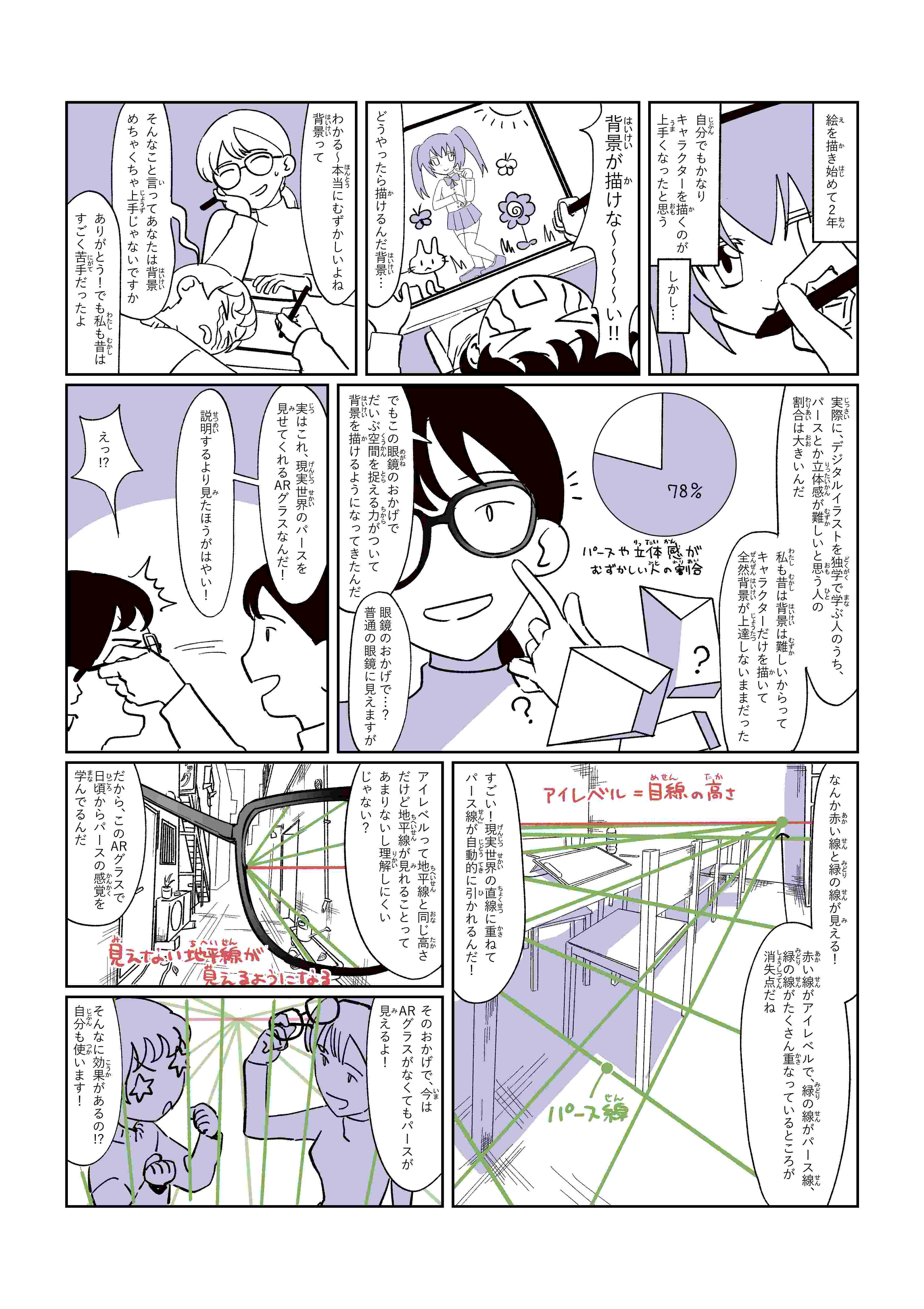
Learning ‘perspective’, which is vital for drawing backgrounds, proves a significant hurdle for beginners. Even if a learner can understand the concepts of perspective, such as eye level (the height of one’s line of sight) and perspective lines (lines that converge towards the distance), working out how to apply these to drawing actual scenery is more problematic. This is why we developed ‘Pers-lens’, an AR glasses-type system that uses AR technology to overlay and display eye level and perspective lines on an actual view. When you look at a building or interior space while wearing Pers-lens, you can confirm your eye level, which represents the height of your eyeline, and see perspective lines that converge towards the distance. This provides a visual comprehension of perspective in your daily environment, giving you an objective understanding of the relationship between your own viewpoint and the makeup of your surrounding environment. Furthermore, by making it easier to obtain a sense of perspective, this system increases fundamental background-drawing skills.

パースレンズ


遠近がわかると、背景の描き方が変わる。

背景イラスト制作に不可欠な「遠近法」の習得は、初学者にとって大きな壁となっています。アイレベル(視線の高さ)やパース線(奥行き方向へ収束する線)といった遠近法の概念は、知識として理解できても、現実の風景にどのように当てはめればよいのかわからないという課題があります。そこで、AR技術を用いて現実の風景にアイレベルとパース線を重ねて表示するARグラス型システム「パースレンズ」を開発しました。「パースレンズ」を使用すると、建物や室内空間を見た際に、目線の高さを示すアイレベルや、奥行き方向に収束するパース線をリアルタイムで確認できます。これにより、普段の生活空間の中で遠近法を視覚的に捉えることが可能となり、自身の視点と空間構造の関係を客観的に理解できるようになります。さらに、遠近法を感覚として身につけやすくなることで、背景描画の基礎力を上げることができます。

Tablet Stone


Realizing a curling stone that maintains a stable information display no matter how much the stone is spinning
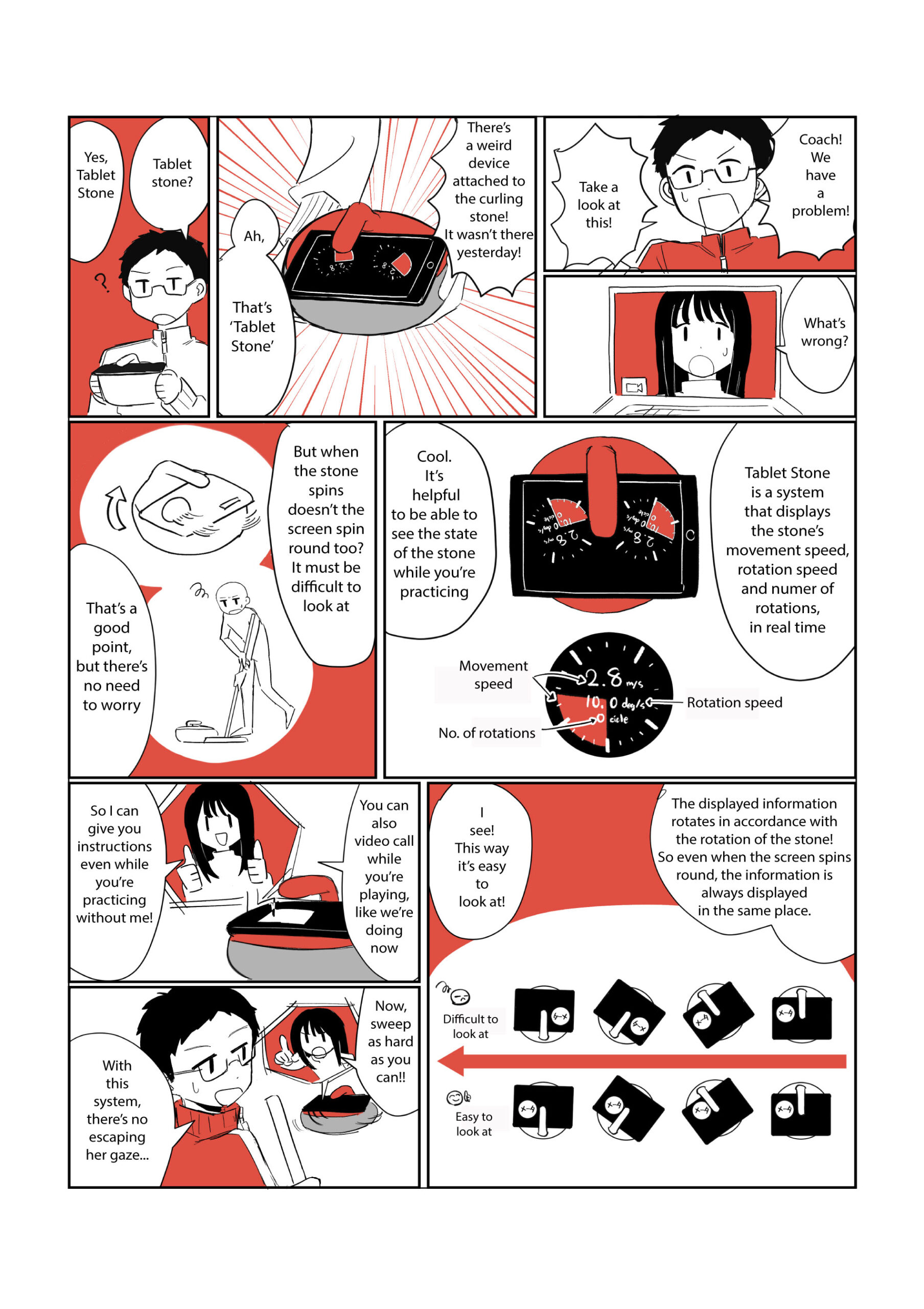
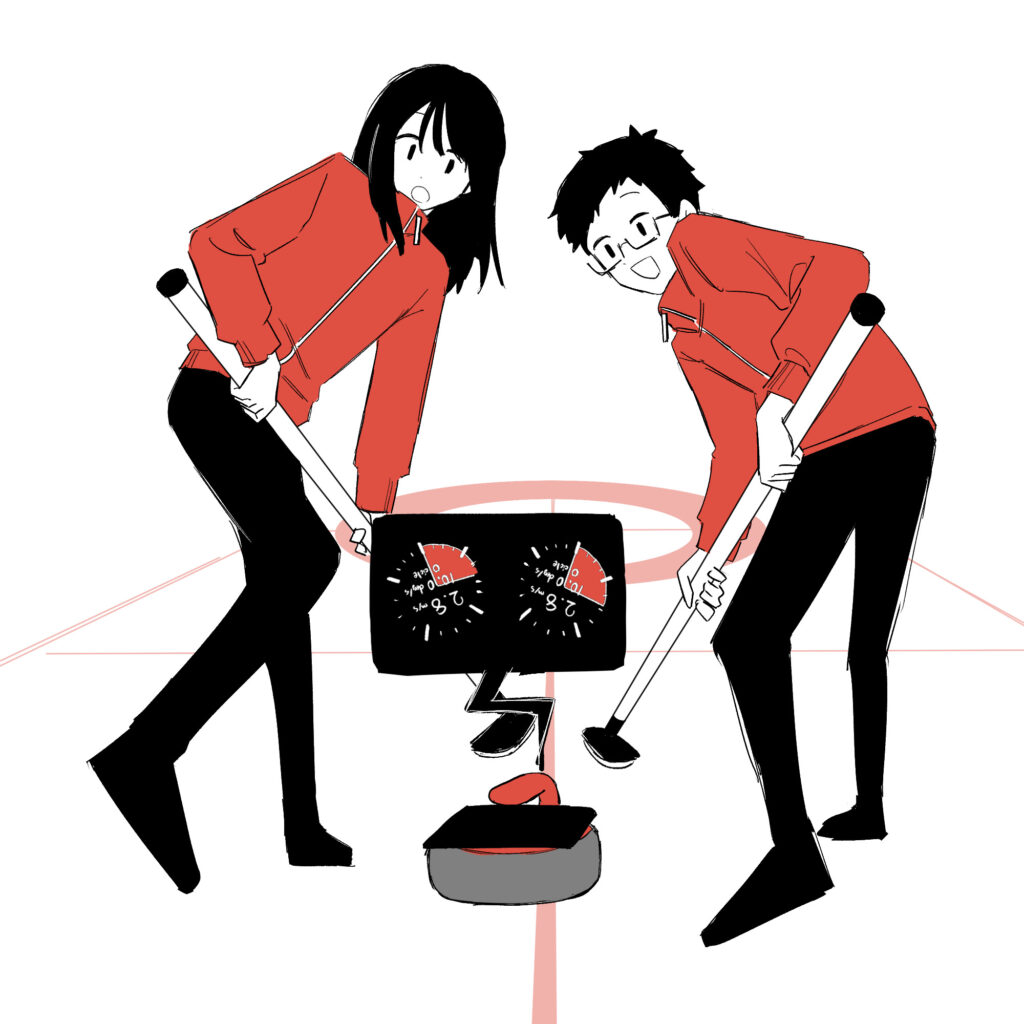
Tablet Stone is an application that was developed for players of curling. This application begins with the placing of a tablet on top of a curling stone. On the tablet, information such as the stone’s movement speed, rotation speed and number of rotations is displayed. This information is important for, for example, the sweepers (the players who sweep the ice with brushes). However, because a curling stone spins as it travels, it is difficult for the sweepers to read information displayed on top of the stone. By making the information display rotate in response to the rotation speed of the stone as it slides across the ice, we make it easy for players to read the data. But seeing is believing, so check out the demo video!

Accomplishment
Guanyu, C., Mori, H., Takegawa, Y., Aihara, S. and Masui, F. (2024). Design and Implementation of a Stone Rotation Measurement System with IMU Sensor and Stone Behavior Presentation System. In Proceedings of the 12th International Conference on Sport Sciences Research and Technology Support, pp. 140–147 (Nov. 2024).

Stone Recoder


Turning curling stones into science

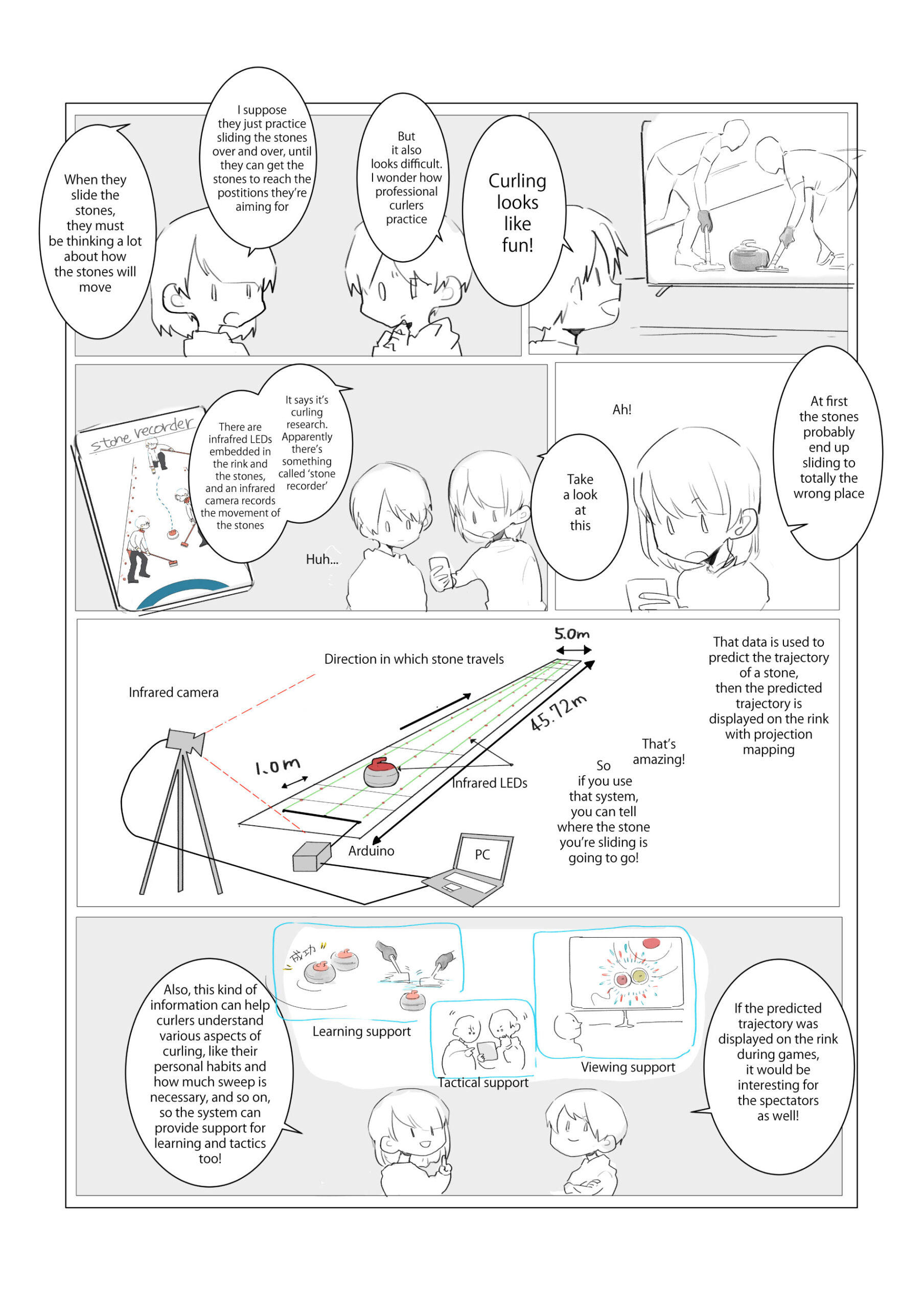
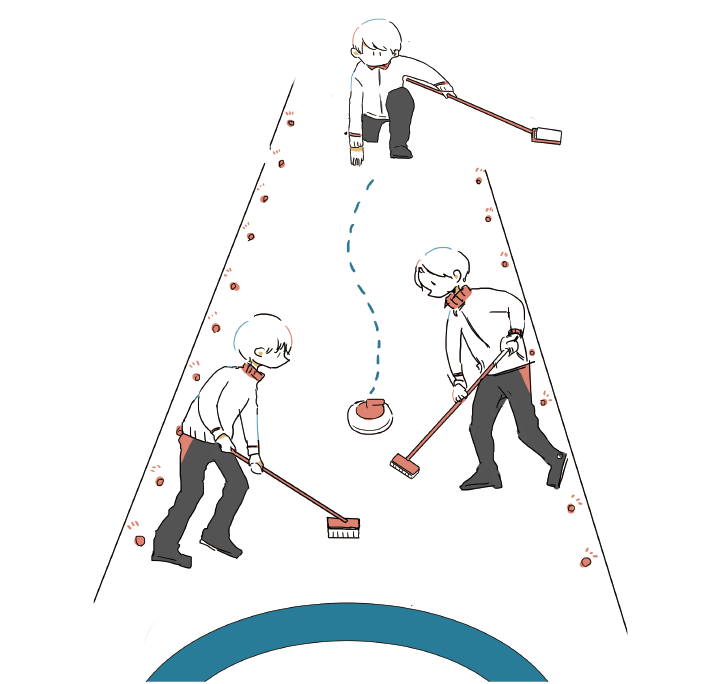
Often called `chess on ice’, curling is known to be a competitive sport that is extremely tactical. However, how the stones used in the sport will move on the ice, and the physical mechanism involved, have yet to be made clear. StoneRecorder uses infrared LEDs and an infrared camera to record the movement of stones and displays their trajectories on the rink, using projection mapping. Making it possible to visualize or predict the trajectory of the stones could change both tactics and practise, and even the nature of spectation.

Accomplishment
Takegawa, Y., Sasaki, N., Aihara, S., and Masui, F., “Development of a Curling Stone Tracking System Using Infrared LEDs, and an Accompanying Application,” In Proceedings of the 11th International Conference on Sport Sciences Research and Technology Support (icSports2023), pp. 136–143 (Nov. 2023).

Smart Bowling Ball


Perceptive bowling ball

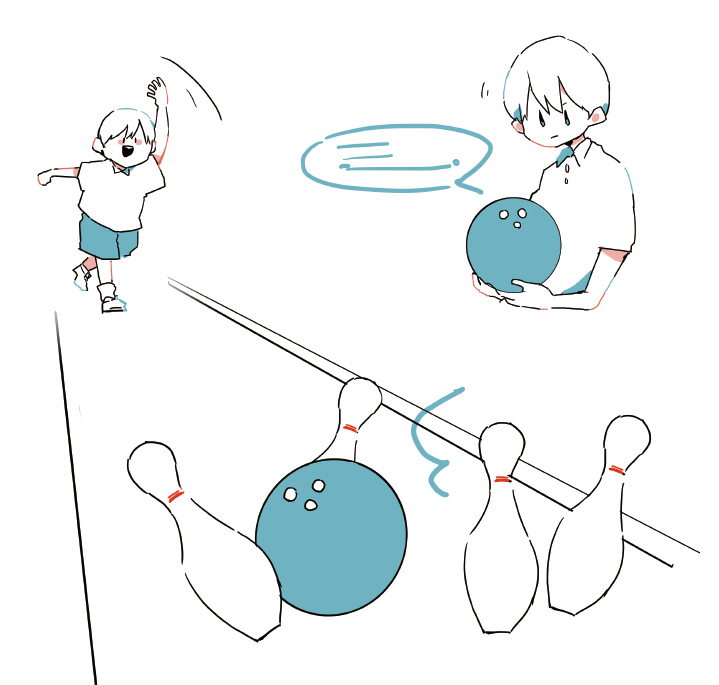
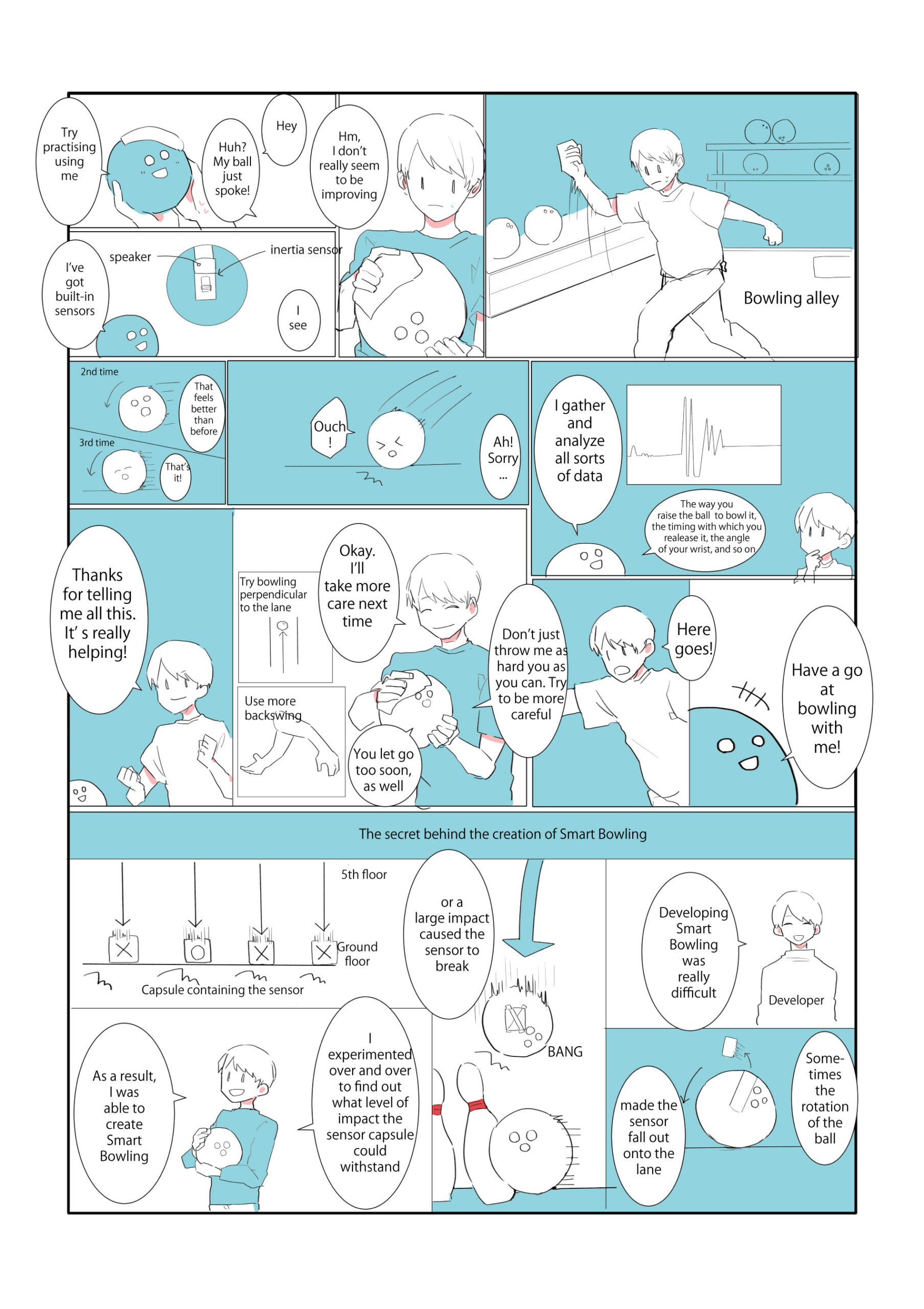
To become good at bowling, it is necessary to consider various factors, such as approach, form and the speed and number of rotations of the ball. However, it is impossible to grasp exactly what state the ball is in once it has been bowled. Smart Bowling Ball has several sensors embedded in it, endowing it with sensory information. By reading the information recorded by the ball, such as speed and rotation, it is possible to confirm the status of the ball after bowling, in more detail and in numerical values. Perhaps we will see a future in which the ball itself gives you advice on your bowling.

Accomplishment
Uraya, S., Takegawa, Y., Hirata, K., “Nagereru-Kun: Design and Implementation of a Bowling Form Reflection Support Application for Beginners,” Proceedings of the 24th International Conference on Human-Computer Interaction (HCII2022), pp. 348-358 (June2022).

Toricolle


Snowboarder’s SNS! Trick & Collection
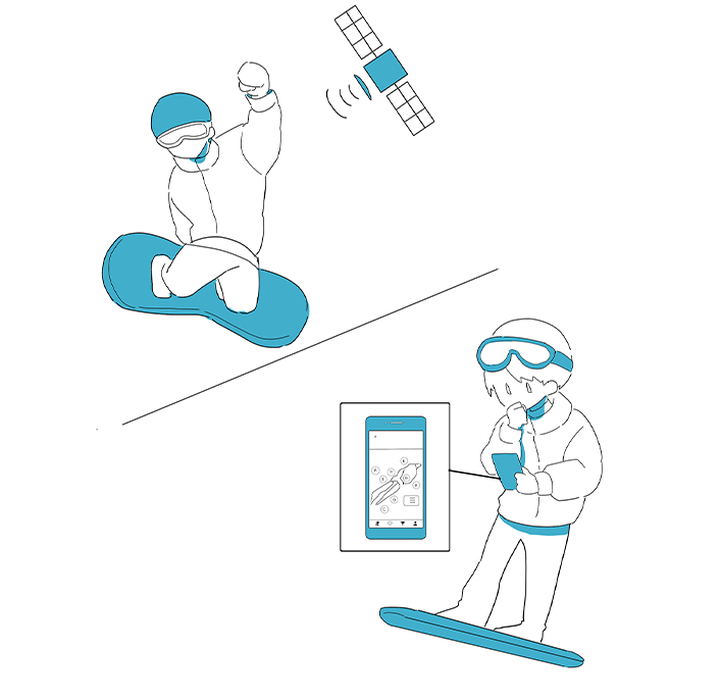
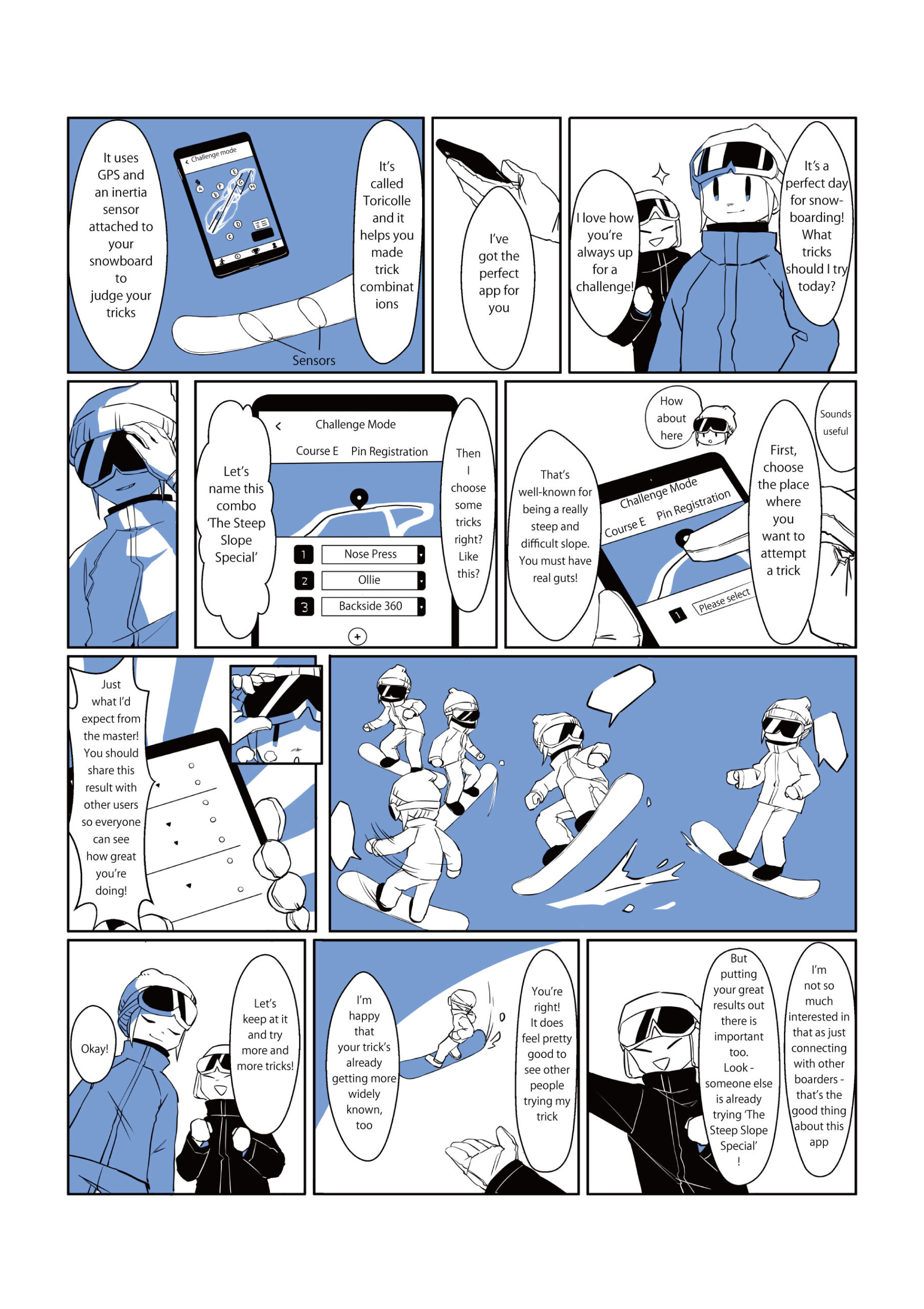
Toricolle is an SNS for snowboarders attempting tricks. Users can share tricks that they have invented with other snowboarders on the SNS. In addition, a sensor mounted on the user’s snowboard enables automatic judgement of whether or not tricks have been successfully performed. Users are awarded badges for attempting and mastering the tricks they have created themselves and those created by other users. Toricolle snowboarders can enjoy building a trick collection, honing their skills and connecting with Toricolle snowboarders around the world, through tricks.